







Across the Deep South, families are navigating rising household expenses, limited savings, and persistent barriers to affordable financial services.1 For workers struggling to make ends meet between paychecks, payday loan apps promise a convenient solution of immediate access to cash, often marketed as interest-free advances on wages already earned. New research reveals, however, that these products can come at a significant cost, leaving borrowers with less money to cover their basic needs and increasingly dependent on repeat borrowing.
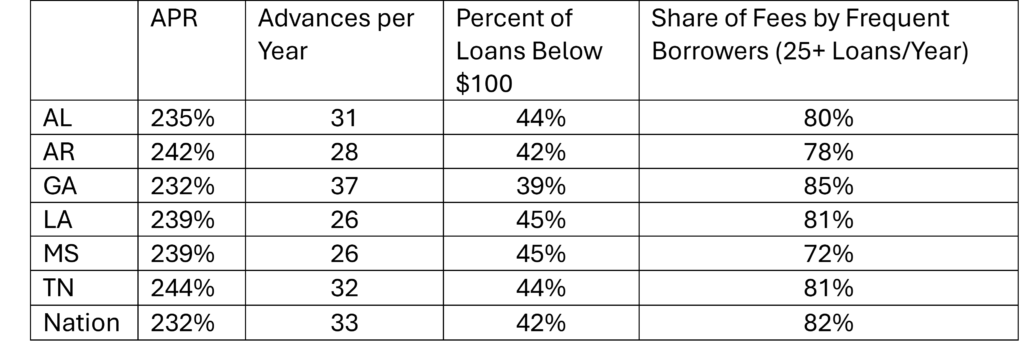
A new study from the Julian Bond Institute, an initiative of the Center for Responsible Lending (CRL), finds that payday loan apps, often referred to as Earned Wage Access (EWA) products, carry triple-digit annual percentage rates (APRs) in every state. Nationally, the average direct-to-consumer payday loan app advance carries an APR of 232%, with 96% of transactions involving fees or so-called voluntary tips. Borrowers are trapped in an average of 33 advances annually, and those who borrow 25 or more times account for 82% of all fees collected. Borrowers across the Deep South face similarly high costs, with APRs exceeding 230% in all six states. See Table 1.
Table 1: Payday Loan App APRs and Repeat Borrowing in the Deep South
Deep South Insights
Although Arkansas and Georgia otherwise enforce strong state usury limits to prevent payday loan debt traps, these EWA loans operate outside these protections. In Arkansas, the average APR is 242%, more than 14 times the state’s constitutional 17% rate cap.2 In Georgia, borrowers take out an average of 37 advances annually, with triple-digit interest rates far in excess of the state’s usury limit, and incur $244 in annual borrowing costs, the highest among the six states. Tennessee has the highest APR in the region at 244%. In every state, approximately two out of five advances were for less than $100. These seemingly small advances can generate substantial costs, particularly for borrowers who repeatedly rely on these products to meet everyday expenses.
The research also reveals how payday loan app fees are concentrated among frequent borrowers. Across the six Deep South states, borrowers taking out 25 or more advances annually account for 72% to 85% of all fees collected. Georgia has the highest concentration at 85%, exceeding the national average of 82%, followed by Louisiana and Tennessee at 81% each. Even in Mississippi, which has the lowest share in the region, frequent borrowers account for nearly three-quarters of all fees. Like other forms of payday lending, EWA products generate a substantial share of their fee revenue from repeat borrowing, despite being marketed as short-term financial solutions.
Echoes of Long-Standing Concerns
These findings reinforce concerns raised by HOPE. Drawing on consumer complaints and national research, HOPE previously documented how these products can push financially vulnerable households into cycles of debt, trigger overdraft fees, and reduce the money available for essential expenses.3
Behind these complaints are families struggling to cover basic expenses after app repayments are withdrawn from their accounts.
- In Georgia, one consumer reported that repayment of an advance left just $17 in their account while they still faced $500 in rent.
- In Tennessee, another consumer described an automatic repayment that overdrew their account by $49 and triggered an additional $30 overdraft fee, leaving them without funds for food, gasoline, and other necessities.
- In Arkansas, a consumer reported that repeated collection attempts following a disputed repayment date resulted in a $570 overdraft.
- A Louisiana consumer living on $940 per month described recurring advances and additional charges that made it increasingly difficult to manage monthly expenses.
These accounts, documented in HOPE’s earlier research, demonstrate how the financial consequences of payday loan apps extend beyond the advertised cost of an individual advance.
Conclusion
HOPE Policy Institute’s research, together with these new findings from CRL, underscores the need for stronger consumer protections, transparent lending costs, and greater access to affordable financial products. As with other forms of payday lending, HOPE will continue to push for stronger consumer protections to prevent these debt traps, including enforcement of existing state interest rate caps, such as those in Arkansas and Georgia, and the 36% cap under the federal Military Lending Act for active-duty service members and their families. Ensuring that low-income and working families are not needlessly stripped of their hard-earned money by predatory loans is an essential step in closing wealth gaps in the Deep South.
Financial innovation should provide a pathway to greater economic stability rather than another mechanism for extracting capital from financially vulnerable households. Across the Deep South, meaningful financial inclusion requires responsible financial services that allow families to meet today’s needs without compromising tomorrow’s financial security.
Footnotes
- Standaert, Diane, and Kiyadh Burt. (2026). “New Data Show Affordability Challenges and Long-Term Consequences for the Deep South”.https://hopepolicy.org/new-data-show-affordability-challenges-and-long-term-consequences-for-the-deep-south/ ↩︎
- Arkansas passed legislation in 2025 authorizing Earned Wage Access products, HB 1815 (2025), https://arkleg.state.ar.us/Home/FTPDocument?path=%2FBills%2F2025R%2FPublic%2FHB1517.pdf ↩︎
- Moorer, Regina, and Diane Standaert. (2026). “Financial Danger: Payday Loan Apps in the Deep South.” https://hopepolicy.org/financial-danger-payday-loan-apps-in-the-deep-south/ ↩︎