







Affordability assistance, such as down payment assistance or help with other upfront costs of homeownership, is one of the most effective tools for expanding access to homeownership. For many families, monthly mortgage payments are manageable, but saving for a down payment and closing costs is a significant barrier.
A home is often the largest purchase a household will make and saving even 5-20% of the purchase price upfront presents a sizeable challenge, especially for first time homebuyers and lower-income households. In addition to down payment barriers, paying the closing costs, the upfront costs of getting a mortgage loan and transferring the purchased property, also pose a significant challenge for many borrowers.
While there are lending programs that require little to no down payment, including HOPE’s Affordable Housing Program where loans can be made for up to 100% of loan to value, applying a down payment to the purchase of a home can reduce a borrowers’ interest rate and the cost of the loan over time. This blog highlights recent data about closing costs in the Deep South and provides examples of how HOPE’s affordability assistance is key in overcoming those barriers to expand access to homeownership in the region.
Rising Closing Costs Create Barriers to Homeownership
Closing costs have risen significantly both nationally and in the Deep South making homeownership further out of reach for more people, particularly lower-income households. As shown in the figure below, closing costs for mortgage borrowers in the Deep South increased from $4,493 to $7,466 from 2018 to 2025. See Figure 1. These changes represent 2.1% of the mortgage loan in 2018 and 2.3% in 2025. This increase was even more significant for borrowers purchasing homes valued at less than $300,000. Closing costs for those borrowers increased 24% as a percent of the total mortgage loan amount from 2.5% to 3.1% from 2018 to 2025.1
To measure closing costs, HOPE used the Home Mortgage Disclosure Act (HMDA) data field “total loan costs” and compared it with “total loan amount.” HMDA’s total loan costs data field includes costs of the loan attributed to the borrower including origination fees, appraisal fees, underwriting fees, discount points (paid to reduce interest rates) and other costs.
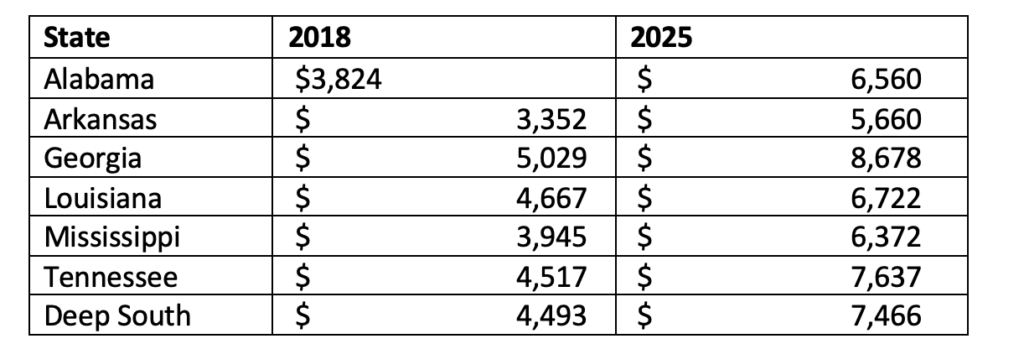
Looking at closing costs by state in the Deep South in Figure 2, the states with the highest total loan costs are Georgia at $8,678 and Tennessee at $7,637. Georgia and Alabama had the largest percent increase from 2018 to 2025 with 73% and 72% increases respectively.
Figure 1: Average Closing Cost Increase in Deep South States 2018 to 2025
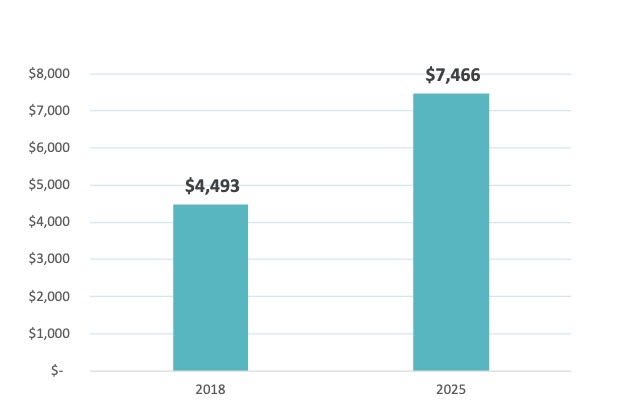
Figure 2: Closing Costs Increase by Deep South State 2018 to 2025
Flexible investments are key
Increased costs are occurring along with cost increases in several other sectors of the economy, not just for housing. As HOPE has shared in other recent analysis, even as costs have risen, people’s incomes have increased to the same degree. Providing capital to CDFIs like HOPE for affordability assistance programs that can be used for a down payment or assist with closing costs is a key opportunity for philanthropy and banks to mitigate rising housing costs and increase access to homeownership.
HOPE has successfully deployed affordability assistance across the Deep South region through several innovative programs some funded by banks or other philanthropic investments, and some from state, local, and federal government initiatives. For example, from 2014 to 2022 HOPE collaborated with Wells Fargo and NeighborWorks America to provide sustainable homeownership solutions in target areas through the Neighborhood LIFT program. HOPE’s coordination of this program and network of participating lenders programs in New Orleans and in Mississippi provided more than 500 borrowers with $7,500-15,000 in down payment assistance and homebuyer education. In the years following the pandemic and still currently, HOPE used CDFI Fund awards to deploy an innovate affordability assistance product in the form of zero-percent second mortgages, such that as borrowers made repayments the funds are recycled to make additional assistance available to more people.
Most recently, in 2025, with support from philanthropic and bank partnerships, HOPE provided affordability assistance to 219 mortgage borrowers, over a third of the people for which HOPE made homeownership possible last year. Of those borrowers:
- 80% of the loans with assistance were to Black households,
- 71% were women headed households,
- 98% were first-time homebuyers,
- and the median purchase price was below $150,002
Allowing flexibility in how the funds can be deployed based on the needs of each borrower can multiply the impact of those funds, whether they need down payment assistance, help with closing costs. Different borrowers may face different barriers, so resources that can cover either down payments or closing costs can respond to the actual financing gap confronting the household. Ultimately, affordability assistance can make housing stability through homeownership and long-term asset building more achievable for Deep South families. An emerging need due to current economic conditions, is for upfront funds to “buy down” a loan’s interest rate. With average 30-year fixed mortgage interest rates increasing to 7.28% last week, the need for funds to reduce interest rates, referred to as discount points, is increasing as well.3 The recent interest rate increase has significantly reduced mortgage demand at HOPE and industry wide with reductions in mortgage applications. Affordability assistance that Includes assistance with closing costs including discount points could help balance out the reduction in demand.
For many families in the Deep South, the distance between being able to afford a monthly mortgage payment and actually becoming a homeowner can be measured in the thousands of dollars required at closing. Affordability assistance can help close that gap. By helping families overcome down payment and closing cost barriers, these investments can expand access to stable housing, home equity, and an asset that contributes to long-term household wealth.
Footnotes
- Hope Policy Institute analysis of Home Mortgage Disclosure Act (HMDA) data for 2018 and 2025 available at https://ffiec.cfpb.gov/data-browser/data/2025?category=states. For the purposes of this analysis, HOPE compared the HMDA total loan costs and the total loan amount data fields. ↩︎
- HOPE mortgage lending data ↩︎
- Freddie Mac Primary Mortgage Market Survey U.S. Weekly mortgage rate averages as of 10/1/2026 available at https://www.freddiemac.com/pmms ↩︎