






A new interactive mapping tool “The Geography of Rural America’s Philanthropic Sector”, developed by the United States Department of Agriculture (USDA) Rural Development Innovation Center, visualizes how philanthropic resources are distributed across rural communities. The tool accompanies the report Rural America’s Philanthropic Sector. Built as an ArcGIS StoryMap, the tool allows users to explore where grant-making organizations are located, how funding flows, and which regions remain persistently under-resourced.
Philanthropic resources in the United States are unevenly distributed, and rural communities face persistent barriers to accessing capital and institutional support. For organizations working across the Deep South, this tool highlights solutions for more intentional, place-based approaches. This blog summarizes key findings from the tool, focusing on gaps in philanthropic investment across rural communities, particularly in the Deep South. The Deep South refers to the states of Alabama, Arkansas, Georgia, Louisiana, Mississippi, and Tennessee.
Uneven Access and a Widening Investment Gap
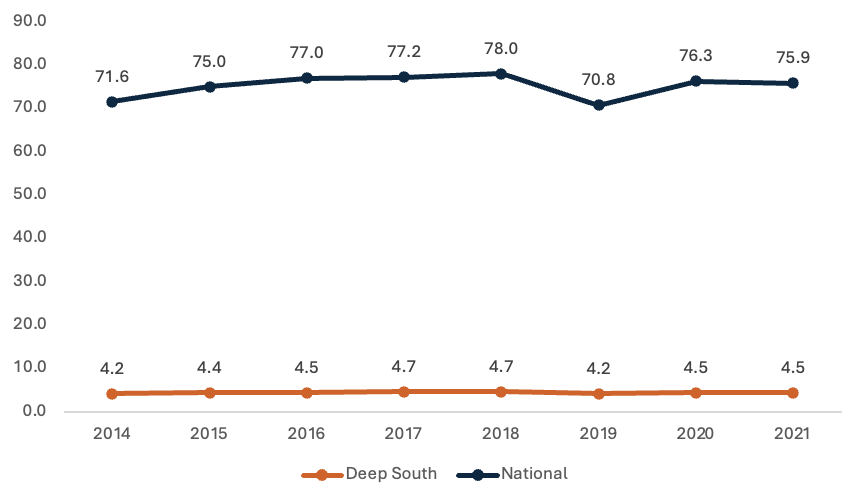
The data reflect both the scale and the limitations of philanthropy in the Deep South compared with the rest of the country. On average, there are about 4.5 grantmaking organizations per 1,000 residents in the region, which is well below the national rate of 76 per 1,000 residents. (Figure 1). This indicates that philanthropic institutions exist across the region but remain limited, likely due to persistently lower incomes and economic mobility than elsewhere in the country. The lower share of active grantmaking institutions in the Deep South also underscores the importance of out-of-region philanthropic resources to drive investment.
Figure 1: Active Grantmaking Organizations Per 1000, 2014-2021
Between 2014 and 2021, organizations located in the Deep South distributed roughly $6.3 billion in grants. This level of giving demonstrates meaningful financial support for communities, nonprofits, and local initiatives. However, compared to other areas of the country, philanthropic dollars do not reach people in the Deep South at the same levels.
Data from the National Committee for Responsive Philanthropy (NCRP) has long shown that the Deep South receives far less philanthropic investment per capita than other regions, especially the Northeast. NCRP data show that between 2010 and 2014, the Alabama Black Belt and the Mississippi Delta received just $41 per person in grant funding.1 This new data tool extends that analysis and shows how little has changed over time. As of 2021, the per capita grant giving in the Deep South was $67.
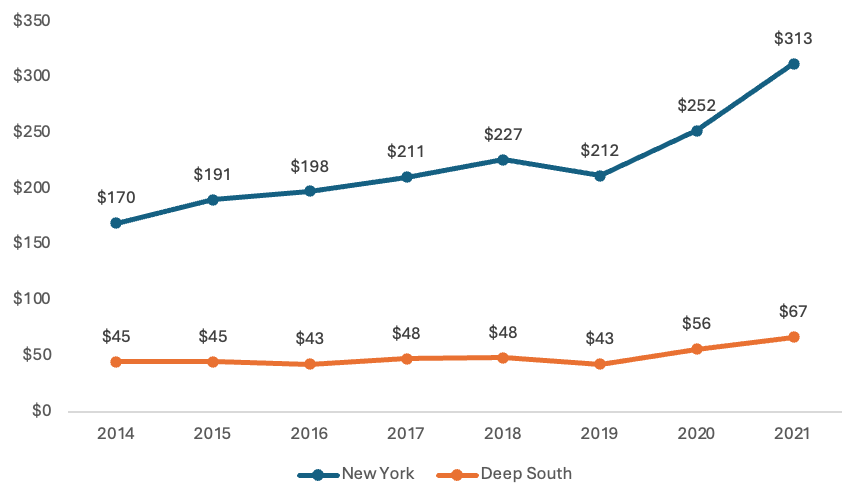
The gap in philanthropic investment between the Deep South and places like New York is also clear and persistent. (Figure 2). As of 2021, per capita grant giving in New York was $313, nearly five times the amount in the Deep South. In New York, grants per capita rose from about $170 in 2014 to more than $300 by 2021, an increase of about 84 percent. The Deep South looks very different. Over the same period, grants per capita in the Deep South increased by only 49 percent, moving from $45 in 2014 to $67 in 2021.
Figure 2: Average Grants Per Capita, Deep South versus New York, 2014-2021
Regional Inequality Mirrors Broader Economic Landscape
The report finds that the Northeast, including New York, leads the country in philanthropic capacity, with the most organizations, the most assets, and the highest level of activity, even for rural areas.2 The Northeastern region leads the nation with the highest number of grants ($148) per capita in rural areas in 2021, per the tool.
Table 1: Grants per Capita in Rural Areas, 2021
| Region | Grants Per Capita |
| Northeast | $148 |
| Midwest | $86 |
| West | $89 |
| Deep South | $48 |
In contrast, the Deep South ranks lowest. It has fewer grantmaking organizations, less capital, and lower funding levels. Per capita grantmaking in the rural Deep South is only about two-thirds of that in the rural Midwest and one-third of that in the rural Northeast. These patterns mirror broader underinvestment that shapes economic outcomes across the region, which reflects the underlying impact of persistent poverty, low economic mobility, and decades of divestment.
Closing the Gap in the Deep South
Taken together, these findings point to a structural challenge in the distribution of philanthropic capital. This creates both a constraint and an opportunity. Rural communities, particularly in the Deep South, are home to institutions, leaders, and organizations already advancing solutions for their communities. What they need is resources. Strengthening rural philanthropic infrastructure, supporting mission-driven intermediaries, and building partnerships that center on local knowledge can shift this dynamic.
Closing the philanthropic investment gap in the Deep South expands access to opportunity where it is needed most.
Footnotes
- Schlegel, Ryan, and Stephanie Peng. As the South Grows: On Fertile Ground. https://ncrp.org/wp-content/uploads/2017/04/As-the-South-Grows-On-Fertile-Soil.pdf. ↩︎
- “Rural America’s Philanthropic Sector: Grantmaking and The Role of Philanthropy in Rural Communities.” USDA Rural Development Innovation Center Data Analytics Division, March 2026. https://www.rd.usda.gov/media/file/download/usda-rd-rural-philanthropy-report-03122026.pdf. ↩︎