




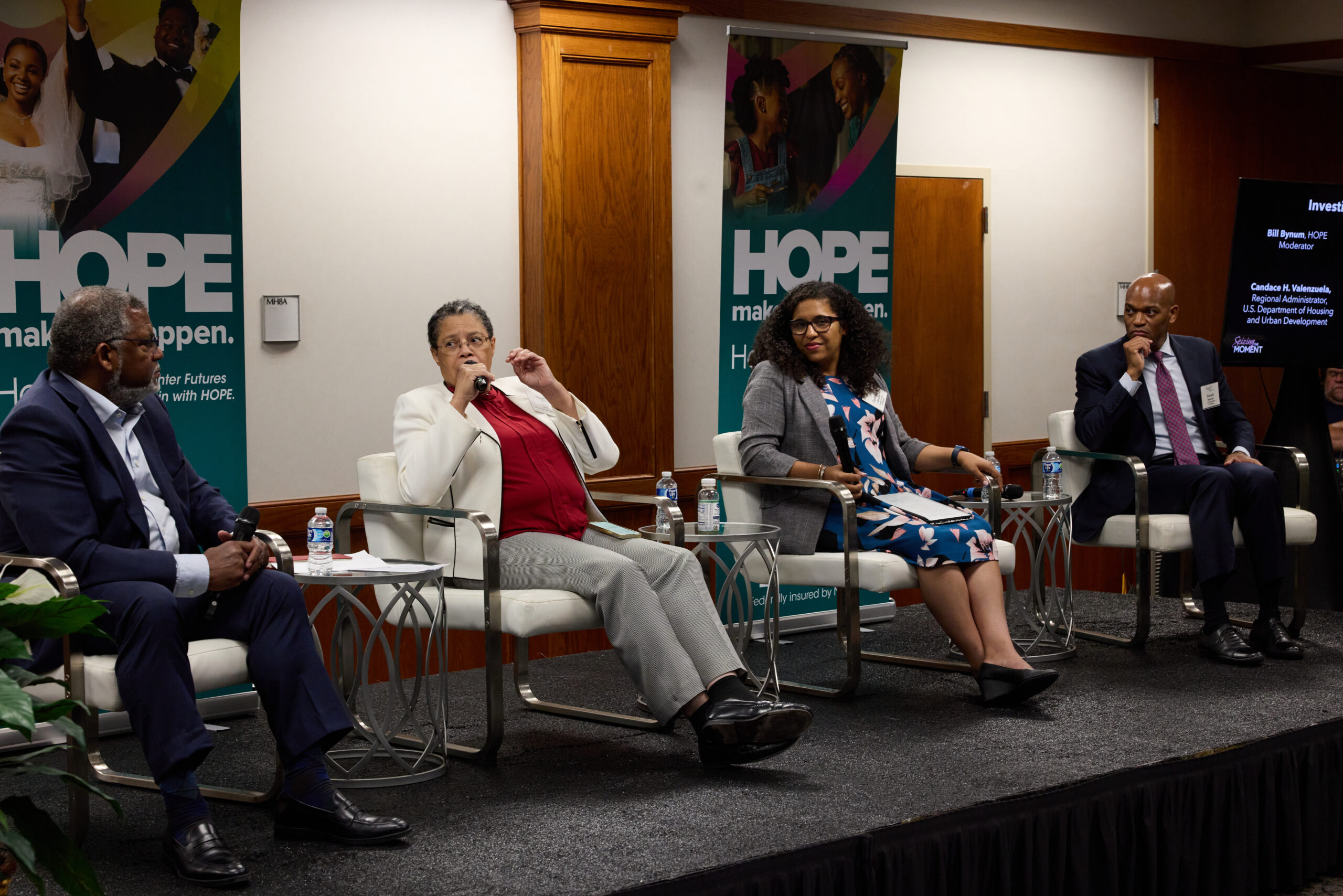


On February 19, 2022, HOPE CEO Bill Bynum testified before the House Financial Services Committee:
“An Unprecedented Investment for Historic Results: How Federal Support for MDIs and CDFIs Have Launched a New Era for Disadvantaged Communities.”
In the testimony, summarized below, HOPE highlights the transformative potential of the recent investments in mission-focused CDFIs and MDIs, and why ongoing and increased investment must continue to close opportunity gaps in the Deep South.
Full Testimony:
Mission-focused Community Development Financial Institutions (CDFIs) and Minority Depository Institutions (MDIs), like HOPE, are on the frontlines of providing vital tools and opportunities to people and communities far too often neglected by traditional banks, credit unions and even some CDFIs.
In December 2020, Congress appropriated an unprecedented level of resources for CDFIs and MDIs to respond to the economic crises existing prior to and exacerbated by the pandemic through the Rapid Response Grant Program, Emergency Capital Investment Fund, and Emergency Support and Minority Lending Program.
These historic investments will be game-changers in the Deep South, and yet, given the scale of the wealth gaps, significantly more is needed to drive economic mobility in the region.
We applaud Congress for enacting these critical resources and urge them to finish the work they have started with this investment in our communities.
These historic investments make the case for appropriate resourcing of mission-focused CDFIs and MDIs with strong track records in reaching historically underserved communities, such as communities of color and persistent poverty areas.
As such, in the hearing, HOPE supported a proposed $4 billion investment CDFIs and MDIs (including CDFI loan funds); allocating 40% of future CDFI Fund awards to community-based lenders with strong reach into communities of color; and ensuring greater transparency and accountability in the deployment of these important resources.
These proposals will fuel the expansion of jobs, small business creation, affordable housing and other community infrastructure in the communities most underserved by other institutions.
In support of these proposals, HOPE emphasized the outsized impact of mission-focused community lenders in reaching communities of color, long before the pandemic and especially during it. For example, HOPE was a leader in organizing CDFIs, MDIs and others to successfully advocate for modifying the $800 billion Paycheck Protection Program in several aspects to ensure it could reach small businesses owned by people of color. Changes included opening it up to serve sole proprietors, reducing barriers for CDFI loan funds, and dedicating PPP funds to be deployed by CDFIs and MDIs.
Did you know?
Consequently, HOPE made 5,216 PPP loans— 89 percent to borrowers of color and 50% to women.
An examination of mortgage data in the Deep South underscores concern about potential disparities in track records among CDFIs and MDIs. Stark examples are evident in Mississippi, where so much of the state qualifies geographically as low-income, and nearly 40% of Mississippi’s population is Black.
Did you know?
Among the 27 CDFI banks headquartered and engaged in mortgage lending in Mississippi from 2018-2020, 68% of mortgage loans went to white borrowers while only 13% went to Black borrowers.
Similar patterns persist in Louisiana as well, where 32.8% of the population is Black. By contrast, over 80% of HOPE’s mortgage loans were made to Black homeowners during that time.
Despite the role that CDFIs and MDIs led by people of color have in increasing access to jobs, businesses, homeownership, and financial inclusion in their communities, they are significantly under-resourced compared to their white counterparts. For example, HOPE research shows how CDFIs led by people of color face a persistent two-to-one asset gap compared to white-led CDFIs. Additionally, MDIs in the region, the majority of which are credit unions, must be adequately supported and sustained to ensure economic opportunity in the region. This includes equitable access to current and future federal resources.
Recommendations
In light of the response by mission-focused CDFIs and MDIs to COVID-19, the outsized role they have made in extending financial services to people of color, and the unprecedented opportunity to scale those with long track records of serving communities most in need, HOPE makes the following recommendations.
- Continued and increased funding for CDFIs through Treasury and other federal agencies.
- Address capital gaps historically faced by CDFIs and MDIs led by people of color, especially given their outsized impact in reaching borrowers and communities of color.
- Provide long-term flexible capital that mission-driven CDFIs can tailor to meet the needs of historically marginalized communities.
- Ensure accountability and transparency in the uses of Funds deployed by CDFIs, both individually and collectively.
- Prioritize CDFIs and MDIs as strategic partners in deploying federal resources to financially fragile, harder to reach, and historically underserved communities.
- CDFIs and MDIs cannot do this work alone, so require banks to do more, directly and in partnership with CDFIs and MDIs.
- Place increased priority on ensuring that MDI ownership by people of color is not lost through mergers or acquisitions.
The scale of the wealth gap is an indicator of the scale of the resources still needed to close it.
As just one example, there is a 26.3% gap in Black and white homeownership in the Deep South, a gap that has grown since the 2008 Great Recession.
While banks and other large financial institutions have a role in closing these gaps, sustained and targeted investment in mission-focused CDFIs and MDIs with demonstrated a commitment to serving people of color is a proven solution for setting the nation on a path toward inclusive economic prosperity.